
The secret to success isn't doing more. It's knowing what matters most.
I recently wrote that success often comes down to three things: knowing where you want to go, developing a credible plan to get there, and executing that plan with extraordinary focus and urgency.
But there's an important assumption buried in that advice.
You have to know what to focus on.
And increasingly, I believe that might be the hardest part.
We live in a world where our attention is constantly under assault. Emails, notifications, meetings, social media, and an endless stream of information compete for our time. Artificial intelligence is making us more productive, but it's also making it easier than ever to pursue a hundred different initiatives simultaneously.
The challenge isn't finding more things to do.
It's deciding what not to do.
The Big Rocks
Stephen Covey popularized a wonderful illustration about prioritization that becomes more relevant the longer I spend in venture capital.
Imagine a professor standing in front of a classroom with a large, empty glass jar.
He fills it with several large rocks until no more will fit, then asks his students whether the jar is full.
They agree that it is.
He then pours gravel into the jar, shaking it until the smaller stones settle into the spaces between the rocks.
Again, he asks whether the jar is full.
This time, the students are less certain.
Next comes sand, which fills the remaining gaps. Finally, he pours in water until the jar is completely full.
He asks the class what they've learned.
One student enthusiastically suggests that no matter how busy your schedule becomes, you can always squeeze in a little more.
Wrong.
The lesson is that if you don't put the big rocks in first, you'll never get them in at all.

The jar represents our finite time and attention. The big rocks represent the things that genuinely matter. Everything else is gravel, sand, and water.
The uncomfortable truth is that most of us spend our days pouring in the sand and gravel, hoping there will somehow be room for the rocks afterward.
There rarely is.
The Discipline of Subtraction
What's interesting is how consistently this same philosophy appears across seemingly unrelated disciplines.
Greg McKeown, in Essentialism, argues for doing fewer things, but doing them exceptionally well.
Dwight Eisenhower famously distinguished between what is urgent and what is important. The two are not necessarily the same.
And Elon Musk's five-step engineering algorithm, used at Tesla and SpaceX, contains a deceptively powerful insight: before simplifying, accelerating, or automating a process, first question whether it needs to exist at all.
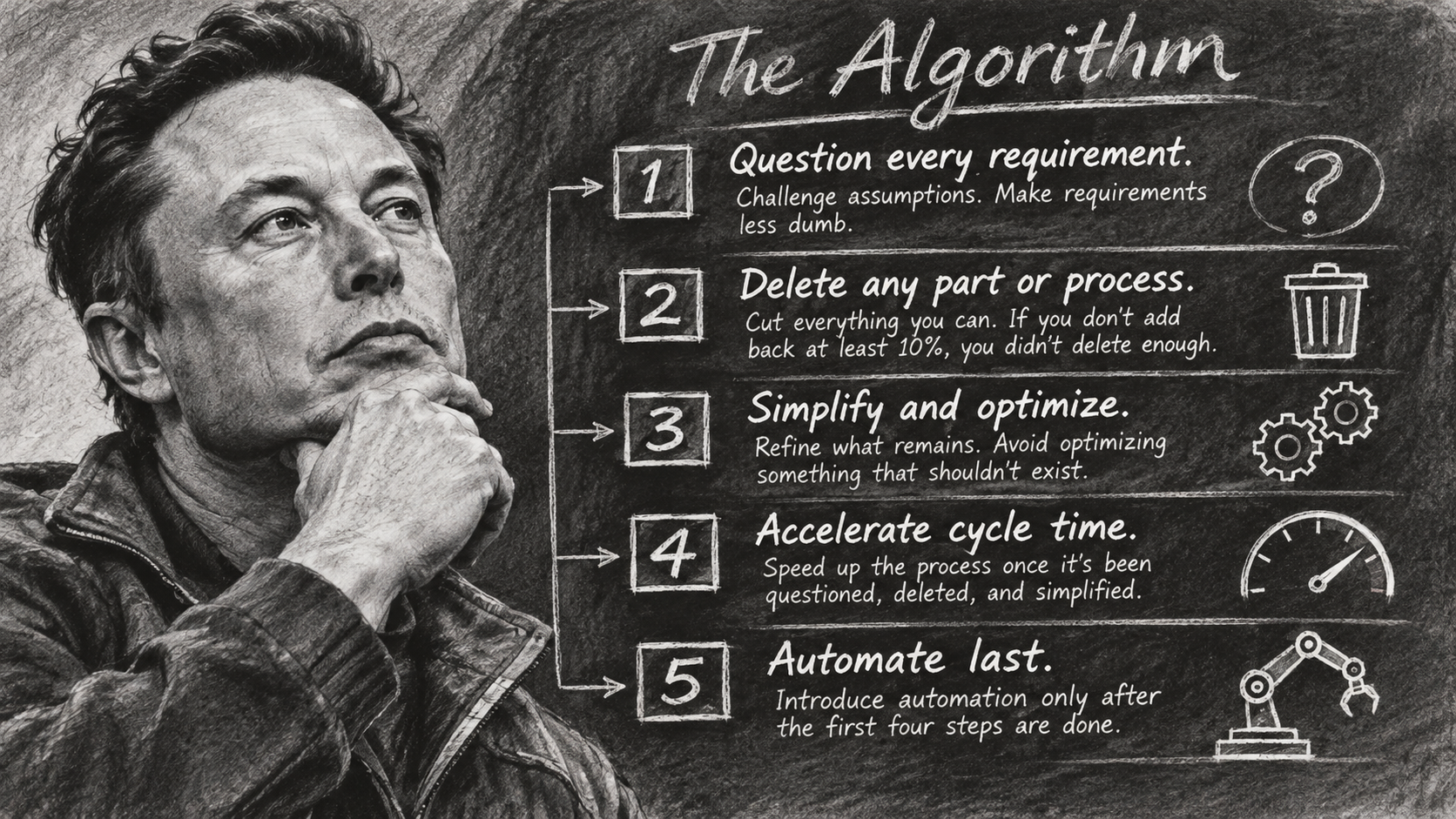
Think about that last point.
How often do companies spend enormous amounts of time optimizing activities that shouldn't be happening in the first place?
How many meetings could be eliminated? How many features should never be built? How many initiatives are consuming resources without advancing the company's most important objectives?
In an era when AI can dramatically accelerate execution, these questions become even more consequential.
AI can make us extraordinarily efficient at doing things that don't matter.
And that's a dangerous form of productivity.
What We Look For in Founders
At Automotive Ventures, we evaluate hundreds of startups every month. Naturally, we're looking for exceptional entrepreneurs operating in large markets, with differentiated solutions to meaningful problems.
But increasingly, I find myself paying attention to something else.
Does the founder know what their big rocks are?
Can they identify the two or three things that will determine whether their company succeeds or fails?
Can they distinguish between the urgent and the important?
And perhaps most tellingly, can they say no to opportunities that are attractive but ultimately distracting?
Early-stage startups operate under extraordinary constraints. Capital is limited. Time is limited. Talent is limited.
The most promising founders understand that those constraints aren't simply obstacles to overcome. They force the kind of prioritization that often distinguishes extraordinary companies from mediocre ones.
The most successful entrepreneurs aren't necessarily the ones who work the hardest or accomplish the most tasks. They're the ones who consistently identify what matters most and direct disproportionate energy toward it.
As investors, we should hold ourselves to the same standard.
Our job isn't to pursue every interesting opportunity. It's to identify the handful of exceptional entrepreneurs and businesses that deserve our capital, attention, and conviction.
I'm becoming increasingly convinced that success has less to do with how much we accomplish and more to do with whether we accomplish the things that truly matter.
In a world where AI is eliminating the constraints on what we can accomplish, the ability to decide what is worth accomplishing may become our most valuable competitive advantage.
We don't need more hours in the day.
We need to get better at deciding what deserves the hours we already have.
Put the big rocks in first.
Everything else can find its place around them.
